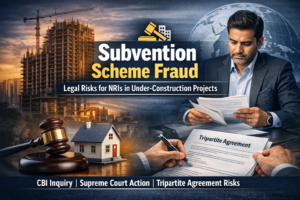
Subvention Scheme Fraud: Legal Risks for NRIs in Under-Construction Real Estate Projects

What Is a Subvention Scheme in Real Estate?

A Subvention Scheme is a financing model offered in under-construction real estate projects where the builder promises to pay EMIs or Pre-EMIs on behalf of the buyer until possession.

  • These schemes are commonly marketed as:
  • Book Now, Pay Later
  • No EMI Till Possession
  • Zero Payment Plan
  • Assured Return Scheme

While legally permissible if structured transparently, many Subvention Schemes have been misused through artificial down payment arrangements, commonly referred to as profile funding.

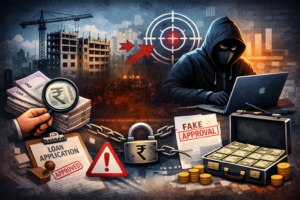
Subvention Scheme Fraud

How Subvention Scheme Fraud Works

  • In fraudulent arrangements:
  • No genuine down payment is made by the buyer.
  • Fabricated receipts are issued to show margin contribution.
  • Funds are temporarily routed through the buyer’s account to create artificial compliance.
  • Banks disburse full loan amounts upfront instead of stage-wise.

RBI guidelines require:

  • Genuine buyer margin contribution.
  • Stage-wise disbursement linked to construction progress.
  • Proper execution of Builder-Buyer and Tripartite Agreements.

Supreme Court Developments (Supertech Matters)

In 2024, the Supreme Court examined irregularities in projects involving Subvention Schemes, particularly in matters concerning Supertech Limited.

On 15 July 2024, the Court granted interim relief by staying coercive recovery actions and directing that cheque bounce proceedings not be initiated against affected homebuyers.

CBI Inquiry and SIT Investigation (18 March 2025)

On 18 March 2025, the Supreme Court ordered a CBI inquiry and constituted a Special Investigation Team (SIT) to examine systemic irregularities in Subvention Scheme transactions.

  • Potential legal exposure may include:
  • Cheating
  • Forgery
  • Criminal conspiracy
  • Banking fraud
Subvention Scheme Fraud

Legal Risks in Tripartite Agreements

Most Subvention Scheme transactions involve execution of Builder-Buyer Agreements, Loan Agreements, and Tripartite Agreements between buyer, builder, and bank.

If the buyer’s contribution was not genuine, the entire loan sanction may be questioned, exposing parties to civil and criminal scrutiny.

Why Subvention Scheme Risk Is Higher for NRIs

  • NRIs face increased vulnerability due to:
  • Physical absence from India during investigations.
  • Limited access to original documentation.
  • Cross-border legal complications.
  • Parallel SARFAESI or DRT recovery proceedings.

Consequences of Subvention Scheme Fraud

  • Possible consequences include:
  • Criminal investigation by CBI or SIT
  • Bank recovery proceedings
  • Damage to CIBIL score
  • Asset attachment
  • Long-term litigation
Profile Funding Scam in India

Strategic Steps for NRIs

  • NRIs should immediately:
  • Obtain complete loan and tripartite documentation.
  • Review RBI compliance.
  • Assess potential criminal exposure.
  • Avoid impulsive litigation without full legal review.

Conclusion

Subvention Scheme transactions in under-construction real estate projects now carry significant legal and regulatory risks. With heightened judicial and investigative scrutiny, NRIs must adopt a carefully structured legal strategy to mitigate potential exposure.